AI Parcel Sortation

Close the gap between rated sorter capacity and actual throughput

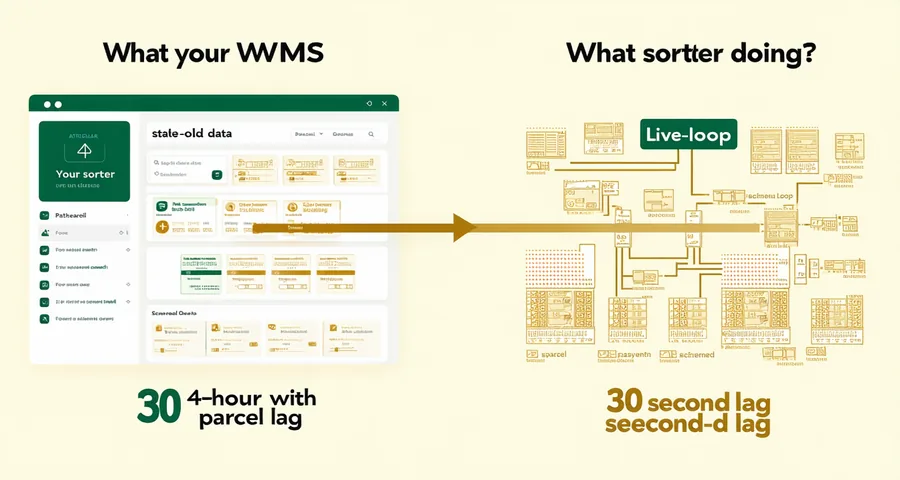
Sortwyre connects to your existing sortation hardware via OPC-UA and continuously adapts induction and divert parameters to your current parcel mix.

20-35% Throughput Improvement

vs. rated sorter capacity in validated deployments

<15 min Adaptive Adjustment Cycle

continuous parameter updates without stopping the line

Near-Zero Mis-Sort Rate

reduced from 8-15 per 10K on high-variability parcel days

5 Team Members

operations, controls, and WMS integration specialists

Six capabilities, one optimization loop

Every parameter adjustment is visible, explained, and operates within the bounds your MHE vendor allows.

Adaptive Induction Rate Control

Continuously adjust parcel induction gap targets without stopping the line.

Sortwyre monitors scanner read-rate trends, divert confirmation latency, and downstream jam sensor activity to dynamically widen or narrow induction gaps during live operation. When scanner read rates drop below threshold—indicating label or parcel orientation issues—the system widens the induction gap to buy time for the divert decision without slowing the belt. Operators see the current rate target and its reason in the dashboard at all times.

Adaptive Induction Rate Control

Divert Timing Optimization

Minimize mis-sorts by calibrating divert dwell time to actual parcel dimensions in real time.

Legacy sortation systems use fixed divert dwell times configured at commissioning and rarely updated. Sortwyre reads the dimensioner output for each parcel and calculates the minimum safe dwell time for that specific parcel’s footprint before the divert arm resets. For oversized or irregular parcels, dwell extends; for small envelopes, it shortens—pushing throughput higher on mixed-parcel days without the mis-sort spike fixed dwell times produce.

Divert Timing Optimization

Belt Health Early Warning

Surface belt and motor degradation signals before they cause unplanned downtime.

Sortwyre ingests motor current draw and belt tension readings alongside the standard PLC event log stream, flagging anomalous deviations 2–6 hours before failure events in validated deployments. Supervisors receive a push alert with the affected zone and a recommended inspection window so maintenance can intervene during a planned break, not during peak throughput.

Belt Health Early Warning

Shift-Level Throughput Benchmarking

Compare actual throughput against rated and historical shift performance without manual report assembly.

At shift end, Sortwyre generates a benchmark comparing actual parcels per hour against rated capacity, the prior 30-shift average, and the best comparable shift in the last 90 days. Breakdowns by zone and hour show exactly where shortfalls concentrated. Reports export to PDF and push to Manhattan WMS or SAP EWM automatically.

Shift-Level Throughput Benchmarking

Parcel Mix Variability Alerting

Alert the operations team when incoming parcel mix drifts outside the calibrated parameter range.

When the inbound parcel mix shifts significantly—for example, a sudden increase in large flat-rate boxes from a single shipper—Sortwyre detects the change within 15 minutes and alerts the supervisor with a recommended induction rate adjustment and the specific parameter change being applied automatically.

Parcel Mix Variability Alerting

WMS Reconciliation Export

Post shift-level scan and sort confirmation data directly to Manhattan WMS or HighJump.

Sortwyre assembles a structured reconciliation record at shift close containing per-parcel scan confirmation, divert destination, and exception flags for reject-lane events. The record posts automatically to the operator’s WMS via Manhattan REST API or HighJump integration layer, eliminating the manual data-entry step that currently sits between sorter confirmation and WMS expected-sort reconciliation.

WMS Reconciliation Export

Four steps from connection to optimization

No cloud dependency for the real-time loop. Connect, baseline, optimize, report.

01

Connect via OPC-UA

Direct connection to your sorter PLC via OPC-UA or Modbus TCP. No cloud relay required for the real-time optimization loop.

02

Establish baseline parameters

Sortwyre reads 30 days of PLC event logs to establish your facility's throughput baseline and current parameter configuration.

03

Run the optimization loop

Every 90 seconds, updated induction rate and divert timing parameters are pushed back to the sorter PLC based on current parcel mix and equipment health signals.

04

Review shift performance

Shift-level performance logs post to Sortwyre's dashboard and export automatically to Manhattan WMS or SAP EWM for operations review.

What the data shows

20-35%

Throughput Recovery

Recovery vs. rated sorter capacity in validated deployments at mid-size fulfillment centers with crossbelt sortation infrastructure.

$0.12-$0.31

Per-Parcel Re-Handle Cost

The per-parcel re-handle cost range eliminated when mis-sort rates approach zero on high-variability parcel days.

90 sec

Optimization Cycle Time

The rolling window Sortwyre uses to calculate updated induction and divert parameters. No human intervention needed between cycles.