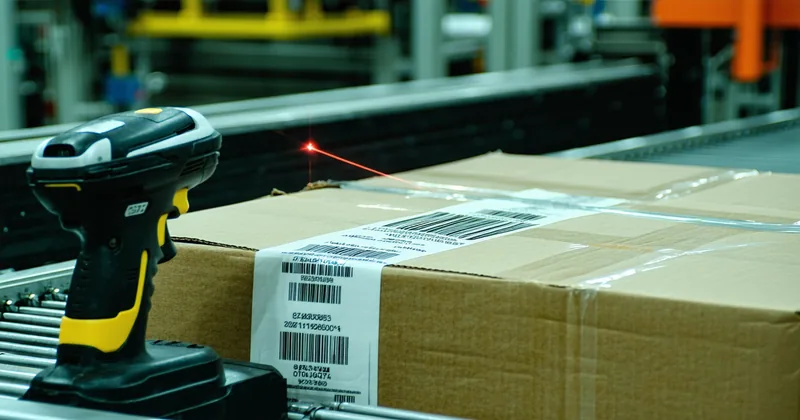
The Label Format Problem Is Not a Scanning Problem
When no-read rates spike in a multi-carrier FC, the first response is usually to look at scan tunnel hardware: camera angles, illumination, focal distance. Sometimes the hardware is the issue. More often, the root cause is upstream — in the label format itself, in the print quality coming off the carrier's label generation system, or in where on the package the label is placed.
A fulfillment center sorting for 6 carriers is handling 6 distinct label standards. Each carrier specifies different barcode symbologies (Code 128, Code 39, QR, PDF417), different minimum barcode quiet zone dimensions, different label size standards, and different placement requirements. A scan tunnel calibrated for the dominant carrier's label format will read that format reliably and may struggle with the others — particularly smaller-format labels with tighter quiet zones, or labels placed in corner positions where the camera angle creates barcode distortion.
Blaming the scanner for a problem that originates in label format diversity is the wrong diagnosis. The right approach is measuring no-read rate per carrier label type, identifying which formats are generating disproportionate no-read events, and tracing those events back to their root cause before adjusting scanner hardware.
Measuring No-Read Rate by Label Type
Most WES platforms log a scan event record for every parcel inducted, including whether the scan succeeded or failed. The missing link in most FC operations is that no-read events are tracked as an aggregate rate — not segmented by carrier label type or by which scan tunnel position failed the read.
To measure no-read rate by label type, you need: the no-read event log from your WES (which scan events failed and at which tunnel position), matched against the carrier assignment for each parcel in the WMS shipment record. When you join those two data sets, you get a per-carrier no-read rate that surfaces which label formats are driving the problem.
The operational pattern this analysis reveals is almost always more concentrated than expected. In a mid-size FC handling 6 carriers, it's typical to find that 2 carriers account for 60–70% of no-read events, often because those carriers have smaller label formats, different barcode aspect ratios, or placement conventions that put the barcode in a scan tunnel blind spot. The other 4 carriers scan cleanly at sub-1% no-read rates.
Knowing this distribution allows targeted intervention rather than blanket scanner recalibration. If Carrier X's label format is generating 4.2% no-read rate while the facility average is 1.6%, the fix is specific to that label format — scanner angle adjustment for that format's typical placement location, label quality specification feedback to the carrier's label generation configuration, or a label placement guide for the packing operation that handles that carrier's outbound volume.
Scanner Tunnel Positioning and Angle Optimization
Most sortation scan tunnels use a fixed camera array covering the top and sides of the parcel as it passes through. This geometry covers the label placement conventions of most carriers for standard rectangular cartons. Two specific conditions consistently produce elevated no-read rates independent of label format quality:
Poly mailers and flat-pack items. Flat packages (thick envelopes, poly mailers, padded flat packs) can pass through the scan tunnel lying flat on the belt — label facing down, invisible to the overhead camera array. This is a placement and orientation problem: inductors need guidance to ensure flat packages are oriented with the label facing the side cameras, not the belt. A visual orientation guide at the induction station that shows correct placement for common package types reduces this failure mode significantly.
Corner-placed labels on cartons with high label density. Some carrier label formats are placed at the corner of the carton rather than the center of a face. When the carton passes the scan tunnel with that corner positioned between camera coverage zones, the barcode may not receive a clean read from any camera in the array. This requires a camera angle adjustment — specifically, adding a lower-angled side camera that captures corner placement positions — or a induction orientation guide that ensures corner-label cartons are turned to present the label face to a camera center-zone.
Scan tunnel geometry changes require physical installation work. The more accessible first step is often the orientation guide: a visual marker at the induction point that inductors can reference for each common package type and carrier format. This is a low-cost operational fix that can reduce no-read rates by 0.4–0.8 percentage points before any hardware change is needed.
Label Quality Feedback from Scan Events to the Induction Team
No-read events generated by degraded print quality — smeared barcodes, low-contrast labels, wrinkled print surfaces — are recoverable before they reach the sort loop if a feedback loop exists between scan event data and the induction team responsible for those packages.
The mechanics of this loop: the WES logs a no-read event with timestamp and induction zone ID. An analytics layer watching that event stream identifies no-read events that occurred at a specific induction station within the last 5 minutes. An alert is generated at that induction station's display or workstation: "Label scan failure at this station — check recent packages for print quality." The inductor can pull the last 3–4 parcels from the queue, inspect for label quality, and either re-print or mark the parcel for manual sort before it enters the sort loop.
This workflow requires two things: the WES to be logging no-read events with station-level granularity (most WES deployments do this), and a monitoring layer that surfaces those events in near-real-time to station-level displays rather than only in aggregate WES reports. The underlying event data is almost always there. The gap is closing the loop back to the induction station before the package proceeds to the no-read spur.
We're not saying this loop eliminates no-read events entirely — some barcode damage happens in transit before the package reaches induction, and some label format incompatibilities require hardware-level fixes rather than operational responses. The point is that a meaningful fraction of no-read events — specifically those caused by packing-line print quality issues — are catchable before they reach the sort loop, and the data to catch them is already being generated.
Label Reprint Workflows at Scale
When a no-read event can't be resolved by label inspection at the induction station — because the original label is genuinely unscannable — the parcel needs to route to a reprint station where a replacement label can be generated, applied, and verified before re-induction.
The throughput cost of a reprint workflow depends entirely on how fast the reprint cycle is. A parcel that takes 8 minutes to move through a reprint station and back to re-induction has consumed 8 minutes of sort floor time for a single unit — roughly equivalent to 60–80 normal induction events at full throughput. At 2% no-read rate on a 12,000 PPH sorter, that's 240 parcels per hour going through an 8-minute cycle. The staffing and throughput math on reprint stations is often underestimated.
Two optimizations reduce the reprint cycle time. First, a reprint station with WMS integration that auto-populates the replacement label from the parcel's tracking number (scanned or manually entered) eliminates the manual order lookup step. Second, locating the reprint station adjacent to the induction zone — rather than in a separate exception-handling area — reduces transit time for the parcel between scan failure and re-induction. Small layout decisions at the no-read handling area compound meaningfully when you're processing 150–300 no-read events per shift.
Tracking No-Read Rate as an Ongoing Operational KPI
No-read rate, measured per carrier label type and per scan tunnel position, belongs on the shift operations dashboard alongside PPH and chute fill rate. It's not a maintenance metric — it's an operations metric that reflects label quality, scanner configuration quality, and inductor practice quality simultaneously.
When no-read rate for a specific carrier label type climbs from 1.2% to 2.8% over three consecutive shifts, something has changed: new label stock with different print density, scanner maintenance that shifted camera alignment, or a training gap with new inductors. The trending data surfaces the change; the per-carrier segmentation tells you where to look. Without that segmentation, a no-read rate increase looks like a facility-level problem that requires a facility-level investigation — when the actual cause is often something much more specific and much more tractable.