

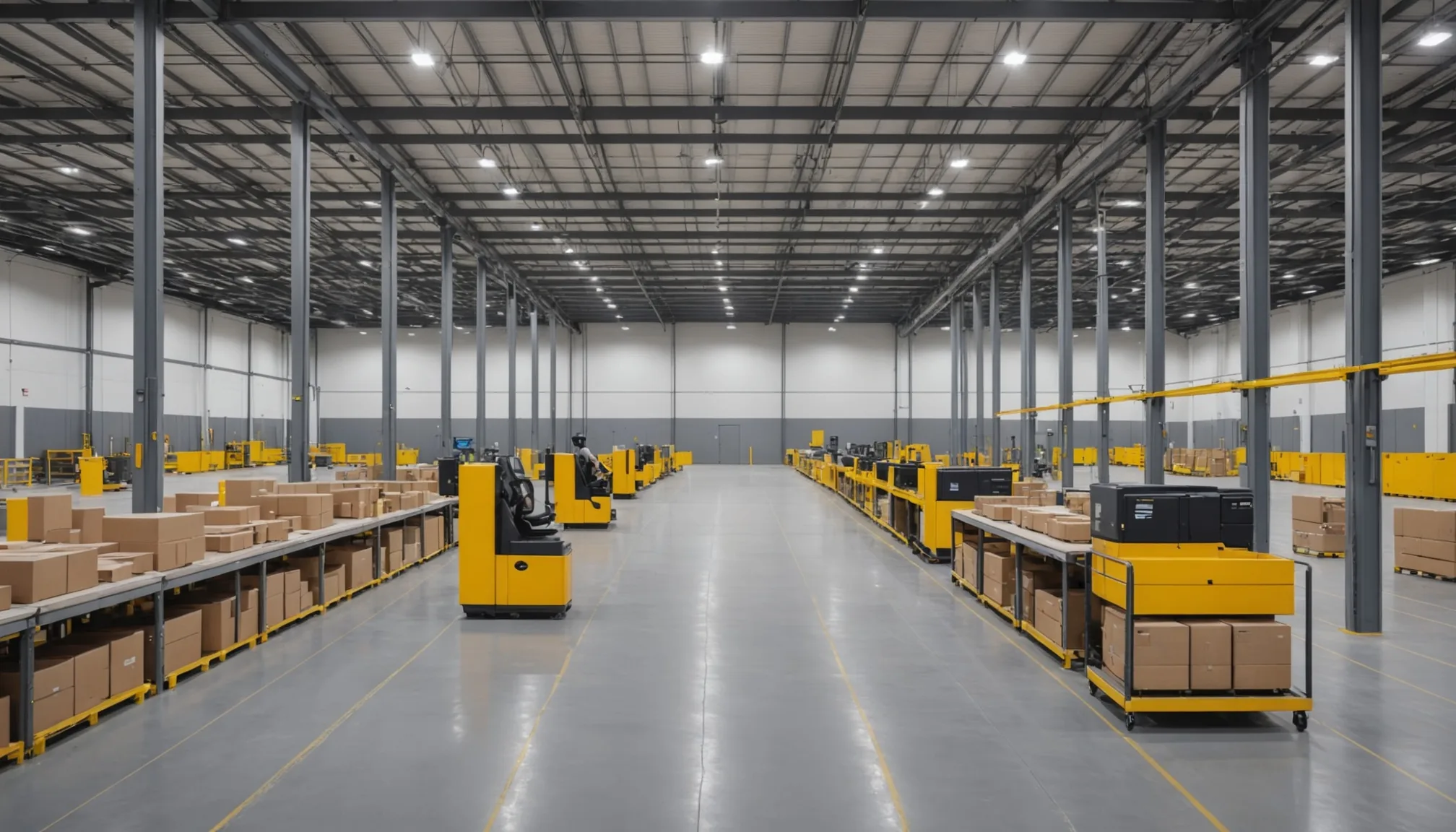
Your sorter runs. Parcels move. The WMS says throughput is fine. And yet, somewhere between "fine" and the rated capacity on the spec sheet, there's a gap nobody can quite explain. We've seen it in facility after facility: a 120,000-parcel-per-shift sorter consistently producing 85,000 to 95,000. The equipment isn't broken. The gap is real. And it has a dollar value.
This article walks through how to quantify that value, build a credible ROI model, and present it to a CFO who didn't come up wanting to fund sortation software upgrades.
Start With the Distinction That Changes Everything
Rated capacity and achievable capacity are not the same number. Not even close.
Rated capacity is what the OEM put on the proposal. It assumes optimal parcel mix, stable induction rates, and sorter parameters tuned for that specific mix. Achievable capacity is what you actually get, day-to-day, with real parcel dimensions, real variability, and parameters set during last year's peak that nobody has touched since.
In our data across mid-size facilities running 15,000 to 80,000 parcels per shift, the gap between rated and achievable is typically 20 to 35%. That's not a hardware deficiency. It's a configuration and adaptation problem. One that software can directly address.
When you're building an ROI case, this distinction matters because the opportunity is sitting in the achievable-versus-rated gap, not in buying new equipment.
The Four Components of Sortation ROI
A complete ROI model has four line items. Operators often calculate one or two and leave the rest on the table.
1. Recovered Throughput Revenue
If your facility bills customers per parcel processed, or if downstream capacity constraints are gated by sorter output, every parcel recovered from the gap has a dollar value.
Here's a concrete example. A facility running 50,000 parcels per shift at a 20% throughput shortfall is leaving 10,000 parcels per shift unprocessed, or pushing them into expensive manual bypass. At $0.18 per parcel in processing revenue, that's $1,800 per shift. Three shifts, five days: $27,000 per week. Annualized at 50 operating weeks: $1.35 million sitting in the gap.
Not all of that is recoverable. A realistic sortation optimization deployment recovers 40-65% of the gap. Call it 50% to be conservative. That's $675,000 per year in recovered throughput revenue from a single facility.
2. Reduced Mis-Sort Re-Handle Cost
Industry-wide, facilities running without active sortation parameter management report 8 to 15 mis-sorts per 10,000 parcels. Each mis-sort triggers a re-handle sequence: pull from the wrong lane, reprocess, re-sort, update downstream systems. In our experience, the fully loaded cost of a single mis-sort re-handle runs $0.12 to $0.31 per parcel, depending on facility layout and labor rates.
At 50,000 parcels per shift, 10 mis-sorts per 10,000, that's 50 mis-sorts per shift. Three shifts, 250 days: 37,500 mis-sorts per year. At $0.20 fully loaded average, that's $7,500 per year. Doesn't sound like much until you realize that number climbs sharply during parcel mix volatility, which is exactly when your optimization software earns its keep.
Facilities with active sortation optimization typically see mis-sort rates drop to 2 to 4 per 10,000. That's a 60-80% reduction. At scale, and at peak, this is where the ROI becomes immediately visible to operations leadership.
3. Avoided Unplanned Downtime Cost
This is the ROI component CFOs are most skeptical about, because it's a cost that didn't happen. Make it real.
Ask your team how many unplanned sorter slowdowns or stoppages they saw in the last 12 months that were traced back to parameter mismatch or induction rate errors rather than mechanical failure. In facilities without adaptive parameter management, that number is typically 3 to 8 incidents per quarter. Each incident averages 25 to 45 minutes of reduced throughput or full stop.
At 50,000 parcels per shift, a 30-minute partial stoppage at 40% capacity loss costs roughly 5,000 parcels of throughput. At $0.18 per parcel, that's $900 per incident. Eight incidents per quarter is $28,800 per year, before you count labor overtime to recover the backlog. That's a number you can defend to finance.
4. Reduced Manual Re-Tuning Labor
Most mid-size facilities have one to three sorter operators who spend 4 to 6 hours per week manually adjusting sorter parameters: induction gaps, speed settings, lane assignments based on parcel mix shifts. That's institutional knowledge wrapped in a spreadsheet, updated by feel.
At fully loaded labor cost of $32/hour, 5 hours per week, 50 weeks: $8,000 per year per operator. That's not the biggest number in the ROI model. But it's the most credible one to a finance team that can verify it directly from payroll data. Use it as your anchor.
Putting the Numbers Together: A Mid-Size Facility Model
For a facility running 50,000 parcels per shift on two to three shifts:
| ROI Component | Annual Value (Conservative) |
|---|---|
| Recovered throughput revenue (50% of gap) | $675,000 |
| Reduced mis-sort re-handle | $22,500 |
| Avoided downtime incidents | $28,800 |
| Labor savings (1 operator, 5 hrs/wk) | $8,000 |
| Total | $734,300 |
Sortation optimization software at this facility scale runs $40,000 to $120,000 annually depending on deployment scope and integration complexity. Payback period: 2 to 3 months on throughput revenue alone. The other three components are gravy.
Facilities running 15,000 parcels per shift see a smaller absolute number but a similar payback profile. At 80,000 parcels per shift, the throughput component alone can exceed $1.8 million per year.
What the Payback Period Actually Looks Like
Three months is aggressive. Six months is typical. That's a payback period most operations capex budgets can absorb without CFO-level escalation.
Here's the thing: the ROI timeline compresses at two specific moments. First, during parcel mix transitions (peak-to-off-peak, new carrier or SKU category onboarding) when manual re-tuning lags behind. Second, during peaks, when the cost of every mis-sort and every slowdown is highest because labor and carrier slots are maxed out.
Both of those moments are exactly when the software earns disproportionate returns. That's not accidental. It's the design premise.
How to Present This to a Skeptical CFO
CFOs who've been burned by "optimization software" pitches before will have one question ready: why isn't this just a configuration problem the vendor or my ops team should fix for free?
Fair question. The answer is that it's an adaptive problem, not a static configuration problem. Parcel mix shifts continuously. Carrier specifications change. Equipment wear affects detection accuracy. A one-time re-tune decays within weeks. What you're buying is continuous adaptation, not a one-time setting.
Present three numbers. That's it. Use the numbers finance can independently verify first: labor hours (from payroll), downtime incidents (from maintenance logs), mis-sort counts (from QC records). Let those anchor the conversation before you introduce the throughput recovery number, which requires a capacity utilization assumption that finance will push back on.
Fact: CFOs accept an ROI model faster when they can validate two of four inputs from existing data before the meeting ends. Build the model so that's possible.
Practical note: bring a 90-day pilot structure to the first CFO conversation. Define the measurement baseline before day 1 (throughput per shift from WMS logs, mis-sort counts from QC, manual tuning hours from operator logs), run for 90 days, compare. The ask shifts from "approve a software purchase" to "approve a measurement experiment." Different conversation entirely.
One More Thing on Capacity
The 20-35% throughput shortfall number will come up in your internal conversation before it ever reaches finance. Someone will say: our throughput is fine, we're not even hitting our contracted volumes.
That's a utilization argument, not a capacity argument. The question isn't whether you're processing enough parcels today. The question is whether you'll be able to handle 20% volume growth next year without adding equipment, and whether you're leaving throughput revenue or carrier penalty avoidance on the table right now during your peak windows.
Achievable capacity is the ceiling that determines your answer to both questions. Closing the gap between achievable and rated is cheaper, faster, and far less operationally complex than adding a sort line. That's the business case. It doesn't need to be more complicated than that.