

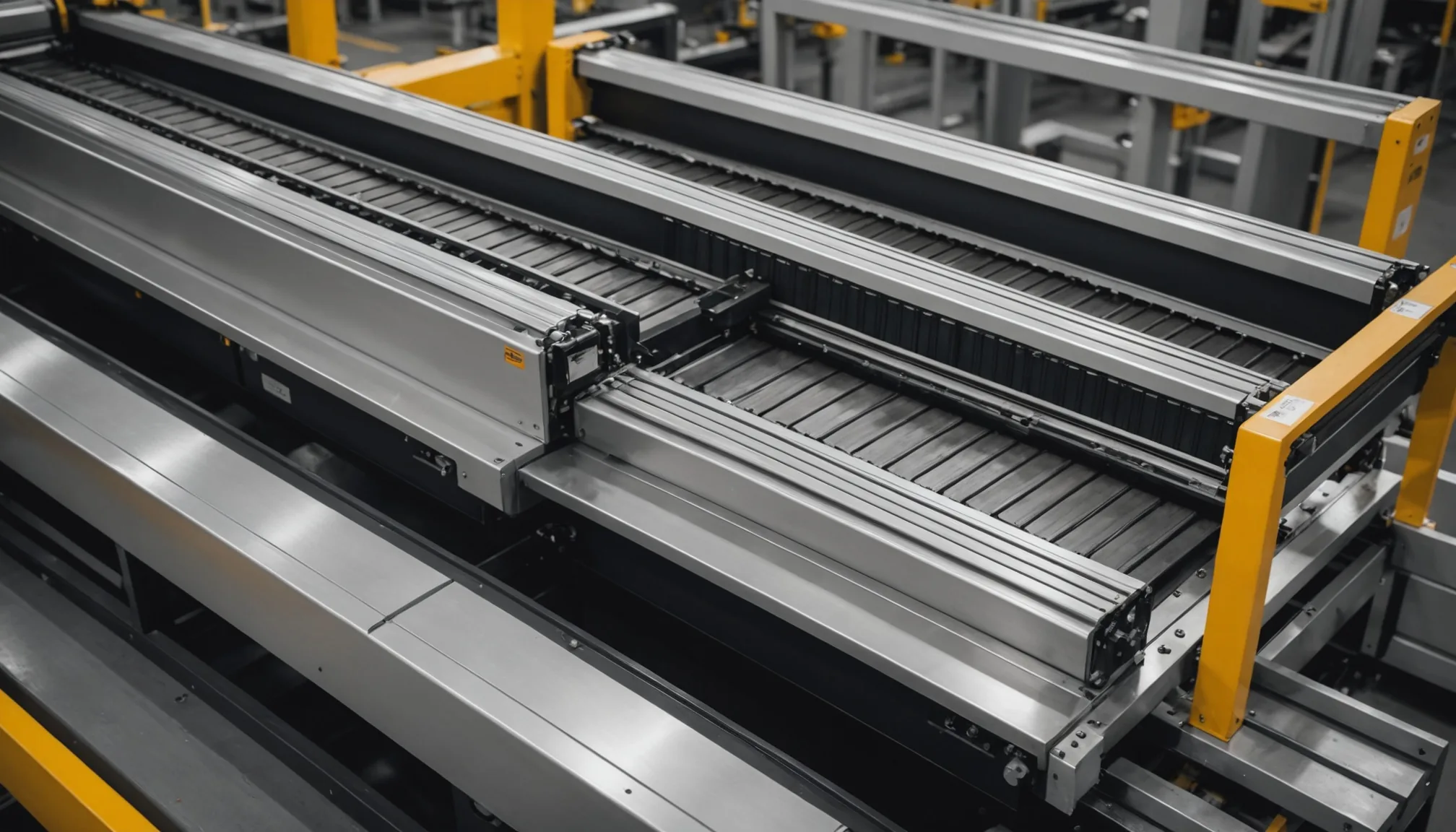
Induction rate is one of those settings that gets configured once during commissioning, written into a laminated card on the control panel, and then quietly ignored for the next three years. That is a problem. The rate your integrator set at 8 AM on a Tuesday with a controlled parcel mix almost certainly does not reflect what your belt needs at 6 PM on Cyber Monday.
What Induction Rate Actually Means
At the most basic level, induction rate is the number of parcels inducted onto the sorter per minute. For a crossbelt system, that translates directly into the gap between successive carriers. Tighten the gap, push more parcels per minute. Widen it, give the system more breathing room per carrier cycle.
Simple in principle. Complicated in practice.
Because induction rate is not just about belt capacity. It is about the entire chain of events that has to complete for each parcel: barcode scan, identity confirmation, divert destination lookup, and physical transfer to the correct chute. Every one of those steps has a time budget. Shrink the gap too far and you start eating into that budget. Scanner read-rate drops. Divert confirmations arrive late. Mis-sorts follow.
We have seen operations running at fixed induction rates that are 20 to 35% below what the system could handle cleanly during normal volume periods. That is throughput left on the floor every shift, not because the belt cannot move faster, but because nobody updated the rate after commissioning.
Why Fixed Rates Stay Fixed
During commissioning, the integration team runs throughput tests with a representative parcel sample and a healthy margin for safety. They pick a number that works. Then they leave.
After that, adjusting induction rate manually requires stopping or slowing the belt, pulling up the PLC configuration interface, running test cycles, validating divert accuracy, and documenting the change. On a live operation, that window rarely exists. In our experience, manual re-tuning after a belt speed change or significant volume shift takes 4 to 6 hours of engineer time. Most facilities do not budget for that mid-season.
So the fixed rate stays. Volume goes up, parcel mix shifts, scanner hardware ages, and the original commissioning number becomes progressively less appropriate. The operation adapts around it, usually by accepting lower throughput during peaks or tolerating slightly elevated mis-sort rates as a normal cost of doing business.
Neither is acceptable. And neither is necessary.
What the Data Actually Tells You
Before you can tune induction rate intelligently, you need two signals: scanner read-rate and divert confirmation latency. Both are already present in your sorter event log. Most operations just are not watching them in the right way.
Scanner Read-Rate as an Early Warning
Read-rate is the percentage of inducting parcels that get a clean, confirmed barcode scan on the first pass. When that number starts dropping below your baseline, it is telling you something specific: either the parcels arriving have harder-to-read labels due to rotation angle, print quality, or damage, or the induction gap is too tight for your scanner array field of view to resolve the code reliably.
These are different problems, but they carry the same implication for induction rate. If label orientation is the culprit, tightening induction gaps further will make it worse. Widening the gap gives each parcel more dwell time in the scan zone. Counterintuitive? Maybe. True? Absolutely. A 4-point drop in read-rate at current gap settings is a signal to widen, not a reason to escalate to maintenance.
Divert Confirmation Latency and What It Signals
Divert confirmation latency is the time between a sort command being issued and confirmation returning from the divert mechanism. Under normal conditions this runs in a tight, predictable band. When it starts widening, it means the system is handling more concurrent lookups or that network latency between the sorter controller and the WMS divert table is increasing.
If induction rate is too high, the controller queues up divert commands faster than they confirm. The result is not an immediate mis-sort. It is a growing tail of unconfirmed diverts that eventually results in a carrier passing its chute before confirmation arrives. The parcel recirculates. Or it diverts late. Neither outcome is right.
Watching confirmation latency trending upward across a shift is a reliable indicator that current induction rate is straining the controller resolution bandwidth. Back off, even if raw throughput numbers still look acceptable.
The Throughput vs. Mis-Sort Tradeoff
Every operations manager knows this tradeoff exists. The tension is between maximizing parcels processed per hour and keeping mis-sort rate within contractual and operational tolerance.
What is less obvious is how nonlinear this tradeoff becomes as you approach the system real induction ceiling. Below a certain threshold, increasing induction rate produces roughly proportional throughput gains with minimal mis-sort impact. Cross that threshold and the curve changes sharply. A 5% rate increase might yield 3% more throughput while driving mis-sort rate up by 40%. That is trading accuracy for volume at an extremely poor ratio.
The threshold varies by parcel mix, label quality, ambient temperature (belt elasticity changes), and time of day (controller responsiveness under load). That is exactly why a single fixed commissioning rate cannot stay optimal across a full operating year. The threshold moves. Your rate should not be static.
How the Sortwyre Optimization Loop Works
Malik Johansson spent three years as a sortation ops supervisor at a Memphis regional parcel hub before building Sortwyre. The starting point was not how to automate tuning. It was: how did we manually figure out when to adjust, and how long did that actually take? The answer to the second question was the problem. Too long. And only when someone thought to look.
Sortwyre runs a 90-second optimization cycle that continuously evaluates the same signals a skilled supervisor would check manually: read-rate trend, divert confirmation latency band, current induction rate, and the rolling mis-sort count for the last 500 carriers. It does not just react to spikes. It detects direction of travel before a threshold gets breached.
When the cycle determines that rate can safely increase, it steps up by a calculated increment and validates across the following cycle before committing. When signals indicate stress, it steps down. The belt never stops. Adjustments happen in flight, within the PLC safe operating envelope.
In practice, this means the system operates at a rate that reflects actual conditions at any given moment, not the conditions present during a commissioning run that may be years out of date.
Specific Scenarios the Loop Handles
Consider a low read-rate period caused by label orientation issues. A typical shift sees a batch of returns with handwritten or damaged labels arriving in the induction queue. Read-rate drops from a healthy 98.5% to 93%. At fixed induction rate, mis-sorts climb until the bad-label parcels clear the system. With dynamic tuning, the optimization cycle detects the read-rate decline within the first 90-second window and widens the induction gap, giving the scanner array more dwell time per parcel. The mis-sort curve flattens.
Conversely, consider a high-confidence period during early afternoon with light volume and a clean parcel mix. Fixed-rate systems run at the same conservative commissioning number regardless. The Sortwyre cycle detects stable read-rate above threshold, confirmation latency within the tight band, and zero recent mis-sorts. It begins stepping the rate upward incrementally. The facility processes the available volume faster and clears the queue before the evening rush begins.
What Operators See on the Dashboard
One concern we hear from ops managers: if the system is adjusting rates autonomously, how does the floor team stay aware of what is happening and why?
Fair question. The dashboard exposes current rate target, the signal values driving the current setting, and the direction of the last adjustment. More importantly, it shows the reason code. Something like: widening gap because read-rate trend is declining. Or: stepping rate up after 3 consecutive stable windows. Operators are not watching a black box. They are watching the same decision logic they would apply manually, running faster and more consistently than any human shift can sustain.
Alerts surface when the system makes a significant step down or when it reaches a floor setting and cannot compensate further. Those are the moments that need human eyes on the induction hardware, the label stock, or the upstream divert controller.
Getting Started With Rate Tuning
If you are running fixed induction rates today, the first step is not buying new software. It is pulling six months of event logs and checking whether your read-rate and divert confirmation latency show systematic patterns by time of day, day of week, or parcel category. Most operations find patterns they were not tracking. That is your baseline.
Once you know where the variability lives, you can evaluate whether manual adjustment protocols are sufficient or whether a continuous optimization loop makes sense at your volume. For facilities processing above 8,000 parcels per shift, the math on throughput recovery from even a 10% rate improvement usually justifies the investment within a single peak season.
The crossbelt sorter does not get more forgiving over time. Label quality varies. Parcel mix shifts. The commissioning number ages. Induction rate tuning is not a one-time task. It is an ongoing operational discipline, and the operations that treat it that way consistently outperform those that do not.